top of page

StreamOps
Reducing Incident Resolution Time Through a Unified Observability Dashboard
When critical outages occur, engineers must piece together alerts, metrics, logs, and traces across multiple tools. StreamOps unifies observability signals into a single investigation workspace, helping teams identify root causes faster and reduce downtime.
During a high-traffic live streaming event, error rates spike and users begin experiencing buffering issues. Engineers must quickly determine the cause, but key observability data is spread across multiple tools. This fragmented workflow slows investigation, increases context switching, and delays resolution.
Objectives & Goals
-
Reduce incident investigation time.
-
Unify alerts, metrics, logs, and traces into one workflow.
-
Surface relevant context at the right moment.
-
Guide engineers through root cause analysis.
RESEARCH
02
Competitor analysis


03
User Needs

04
Product user challenges

05
This system is used by engineers who are responsible for keeping large-scale systems running reliably. This includes SREs, Backend/Platform Engineers and On-call Engineers. These users often work under pressure during live incidents, where fast decision-making is critical.
User Persona

06
Task Mapping

07
Root cause analysis (RCA)

08
5 why Analysis

09
Eisen Hover Matrix

10
Constraints


WIREFRAMES
01
Provides engineers with a high-level overview of active incidents, severity, impacted services, and key system health indicators to accelerate initial triage.
Incident dashboard

02
A shared timeline that visualizes error rates and latency spikes, helping engineers quickly identify anomalies and focus investigations on the most critical time windows.
Error & Latency Timeline

03
Combines health metrics, dependencies, deployments, and configuration updates in a single view to help engineers assess service impact and identify potential causes faster.
Service detail

04
Groups related errors into meaningful patterns, surfaces likely root causes, and automatically connects logs to relevant traces to reduce investigation time.
Logs panel

05
Visualizes request paths and service interactions, helping engineers pinpoint where failures occur and identify performance bottlenecks.
Trace view

06
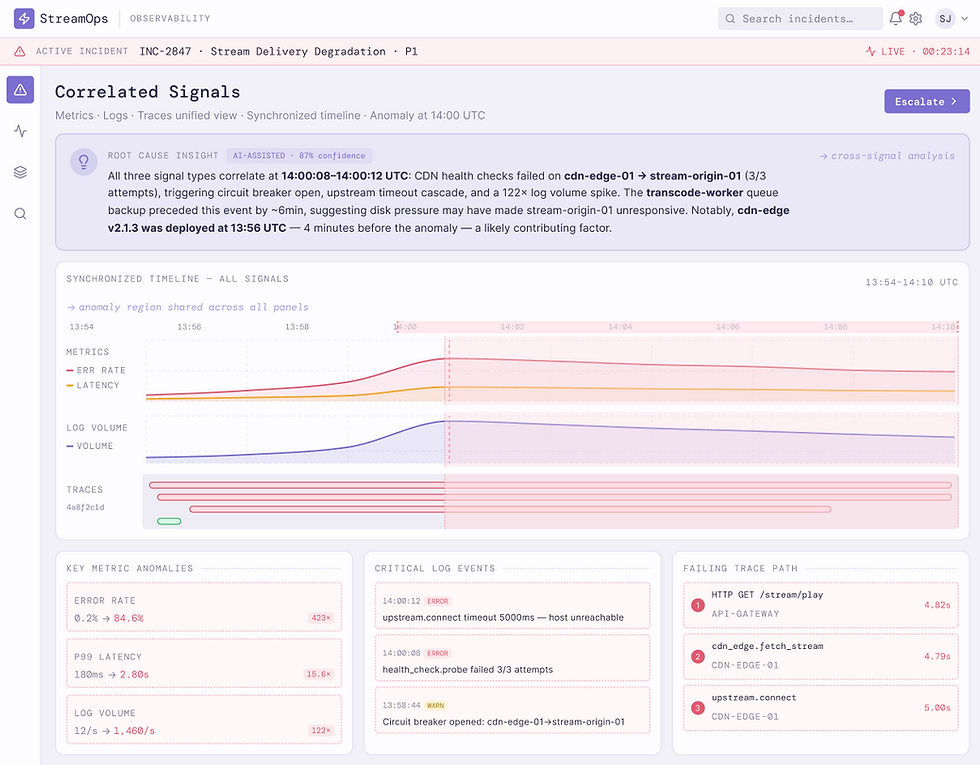
Automatically correlates observability signals across tools, reducing manual analysis and helping engineers validate root causes with confidence.
Correlated signals
07
Summarizes findings, affected services, and recommended next steps to improve communication and accelerate resolution.
Resolution & escalation

bottom of page